


Talmont-sur-Gironde
A Medieval Bastide on the Estuary
Walking into Talmont feels like stepping back 700 years. The village is famous for its white-washed Saintongeais houses with their iconic blue and green shutters.
The Big Highlights
Sainte-Radegonde Church
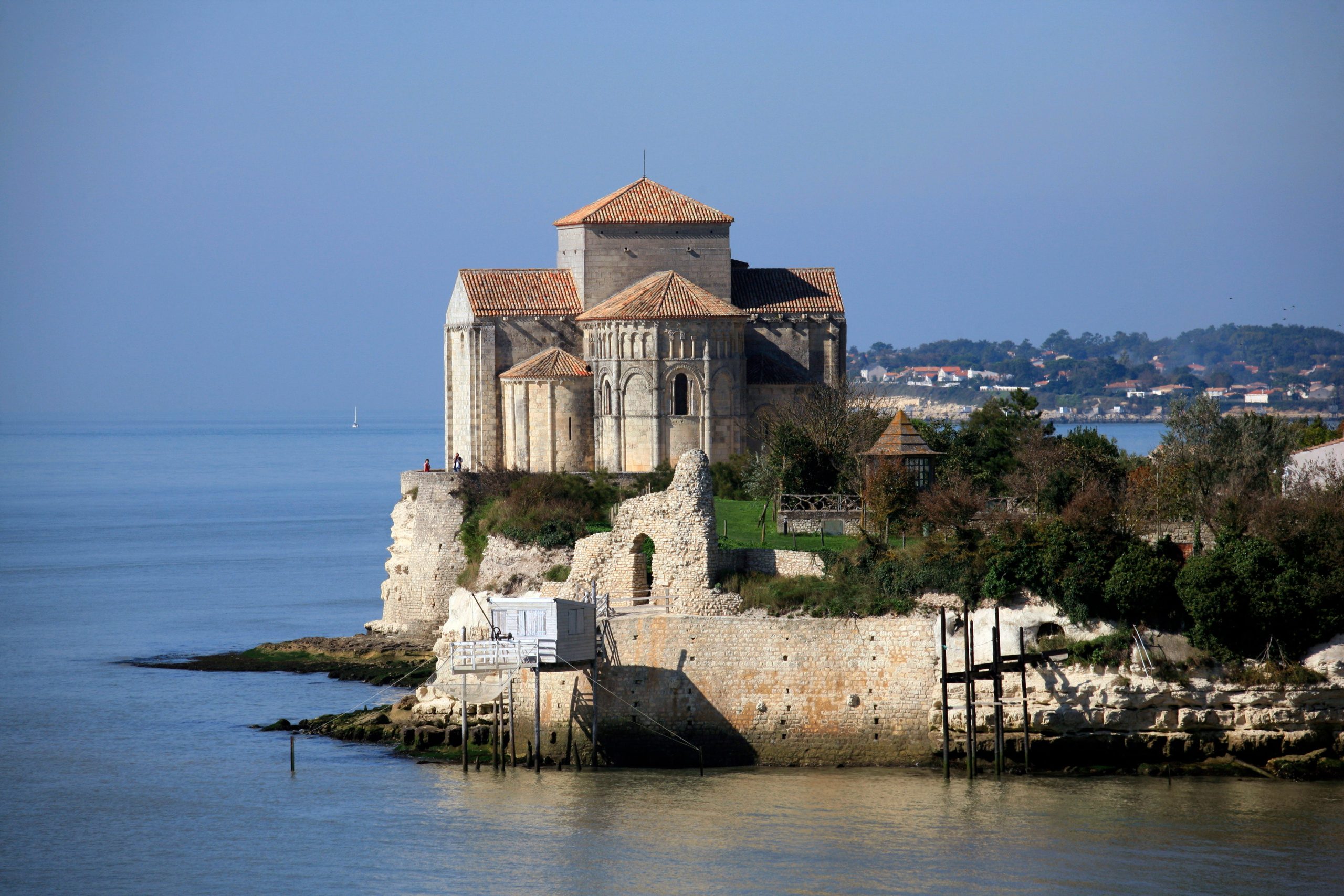
A 12th-century Romanesque masterpiece perched on the cliff’s edge. Look for the marine cemetery next to it—the “sea view” graves are hauntingly beautiful.
The Rampart Walk
Follow the old stone walls that once protected the town from English and Spanish invasions. You’ll see the traditional “Carrelets” (fishing huts) hanging over the water.
Artisanal Shops
Rue du Port is lined with local craftspeople. Look for “Un Monde de Verre” for hand-spun glass jewellery or “Oh Pardi!” for unique local gifts.
The Small Port
Once a hub for sturgeon fishing and caviar production, it’s now a quiet spot to watch the tide change across Europe’s largest estuary.
Planning Your Visit
⏰ Best Time to Visit:
- Late Spring/Early Autumn: Everything is open, but the crowds are thinner.
- Tuesday Nights (Summer): The village is often lit entirely by candlelight for “Les Nocturnes de Talmont”.
🗺️ Getting There: It is a short 20-minute drive south of Royan.
📸 The 4 Best Photo Spots in Talmont
The “Hollyhock Alley” (Rue de la Brèche)
The classic Talmont shot. Frame the white houses and blue shutters with the tall pink Roses Trémières in the foreground. Best in July and August.
The Cliffside Church (Sainte-Radegonde)
Walk around the back of the church to the ramparts. Capture the Romanesque arches against the massive backdrop of the gray-blue Gironde estuary.
The “Carrelets” View
From the northern ramparts, look down toward the water. You’ll get a perfect high-angle shot of the iconic wooden fishing huts on stilts.
The Marine Cemetery
One of the only cemeteries in France with a sea view. The white stone crosses and wild flowers against the horizon are incredibly peaceful and poetic.
A Journey Through Time
700 Years of Fortress & Faith
The English King’s Vision
Edward I, King of England and Duke of Aquitaine, purchased the rocky promontory to build a Bastide (a fortified town). His goal? To control the Gironde estuary and protect his wine trade ships from rivals.
The Hundred Years’ War
Because of its strategic location, Talmont was a constant prize. It changed hands several times between the French and the English before finally becoming French for good in 1451.
The Spanish Sabotage
During the “Fronde” civil wars, Spanish troops occupied the village. Upon leaving, they blew up the massive ramparts and the medieval castle. Most of the stone you see in the village houses today was scavenged from those ruins.
The Caviar Capital
In the 19th and early 20th centuries, Talmont was a world-class center for sturgeon fishing. “Esturgeon” were so plentiful that fishermen sold the eggs (caviar) to travelers for a few francs!
A Living Monument
Now protected as one of the “Plus Beaux Villages de France,” Talmont is a car-free sanctuary that preserves its medieval grid layout perfectly.
Getting to Talmont-sur-Gironde
Routes from Chenac & Royan
You are only 8km (about 11 minutes) away! It’s the perfect distance for a quick sunset visit or a morning market run.
By Car (The “Route Verte”)
From Chenac: Take the D145 west. It’s a straight, beautiful shot through the vineyards and marshes. Look out for storks in the fields!
From Royan: Follow the D25 south through Meschers. It takes about 20 minutes.
By Bike (Canal des 2 Mers)
The famous “Canal des 2 Mers” cycle path passes right through Chenac. It is a very easy 30-40 minute ride to Talmont, mostly flat with stunning estuary views. You can leave your bikes at the dedicated racks at the village entrance.
By Bus (Cara’Bus)
Take Line 32. It connects Royan, Meschers, Talmont, and Chenac.
Note: This service is frequent in summer but limited in the off-season. Check the Cara’Bus app for real-time 2026 schedules.